Download the pre-print (PDF).
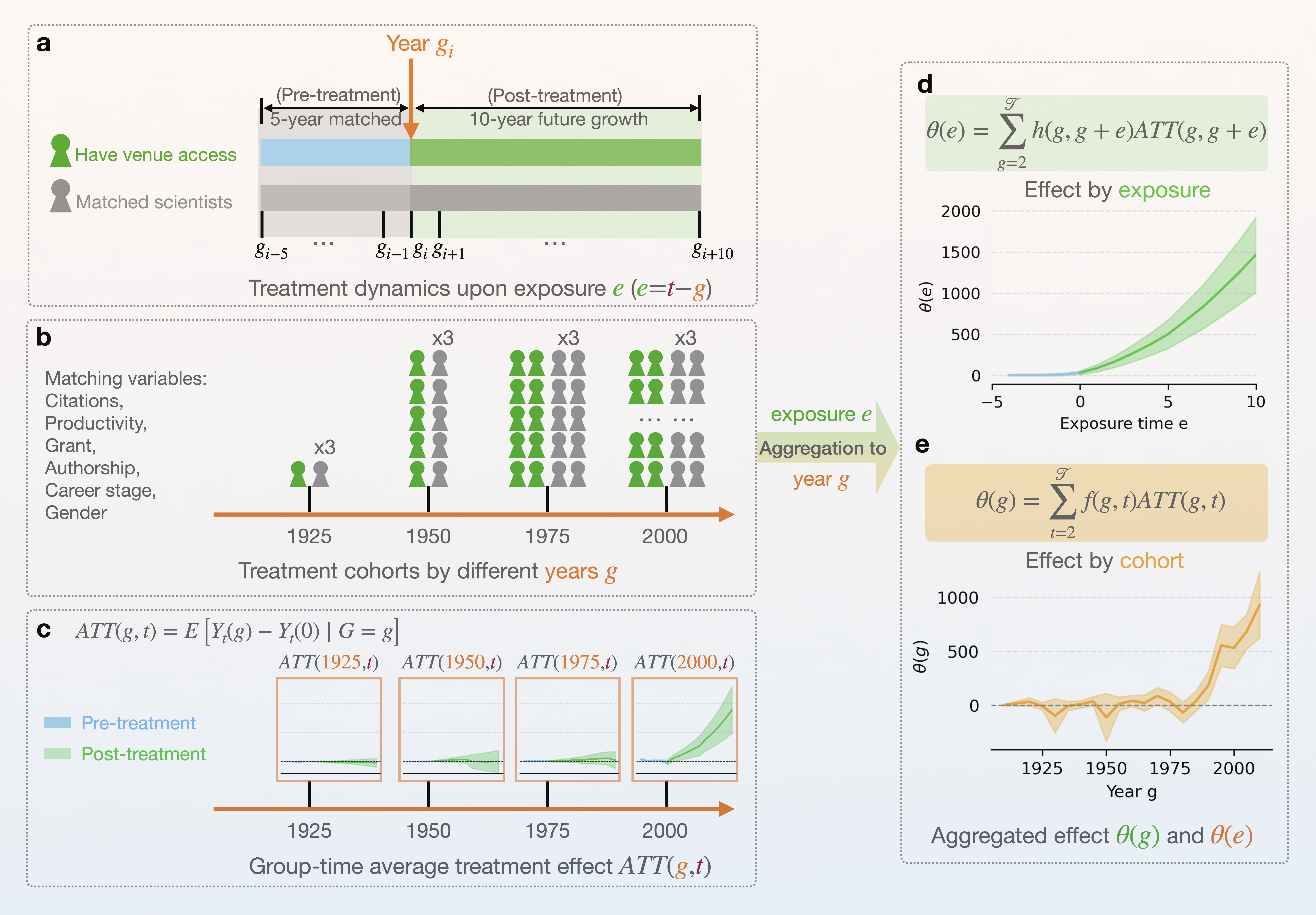
Prominent venues—top journals in science, major biennials in art—act as gatekeepers that shape career trajectories. But who actually benefits from gaining access to these platforms? In this work, we reconstruct the full careers of 3.4 million scientists across physics, chemistry, biology, and sociology, alongside visual and performing artists, to quantify the causal impact of venue access on downstream career outcomes.
Using heterogeneous difference-in-differences analysis, we document a statistically significant and long-lasting venue effect in both science and the arts, and show that it is a relatively recent phenomenon—becoming a prominent force only after the 1990s. Critically, the benefits of venue access are neither universal nor equitable: they are modulated by career stage, gender, and geography.
In science, the venue effect reinforces existing inequalities—disproportionately benefiting male, senior, and Western-affiliated researchers. In the visual and performing arts, however, venue access can partially mitigate gender disparities, offering early-career artists greater visibility. Geographically, prominent venues primarily benefit creators from regions with established traditions in their field, while the gains for those from less developed regions are often limited and not always sustained.
These findings highlight a dual character: venue access can both amplify existing disparities and, under certain conditions, provide opportunities for underrepresented groups.